What You Are Actually Replacing: A Hand Wash Comparison
Most people arrive here with a supermarket hand wash by the sink. So comparing our shelf against itself is not much use to you. Here is the more honest comparison: what is typically in the bottle you already own, and what is in the ones we sell instead.
Every line below is taken from the ingredient list published on our own product page, and each one links through so you can read the full list yourself. We re-checked all four against the live pages before publishing this.
A typical supermarket hand wash
This is a composite of what commonly appears in mass-market hand wash, not a claim about any particular brand. Formulations vary and change.
- What actually cleans: sodium laureth sulfate or sodium lauryl sulfate, the most common surfactants in mass-market hand wash, often with cocamidopropyl betaine
- Preservative system: frequently isothiazolinones, including methylisothiazolinone, sometimes blended with methylchloroisothiazolinone
- Fragrance disclosure: parfum, undisclosed, plus a colourant
- Packaging: single-use plastic. Refills exist but are the exception
The four we stock instead
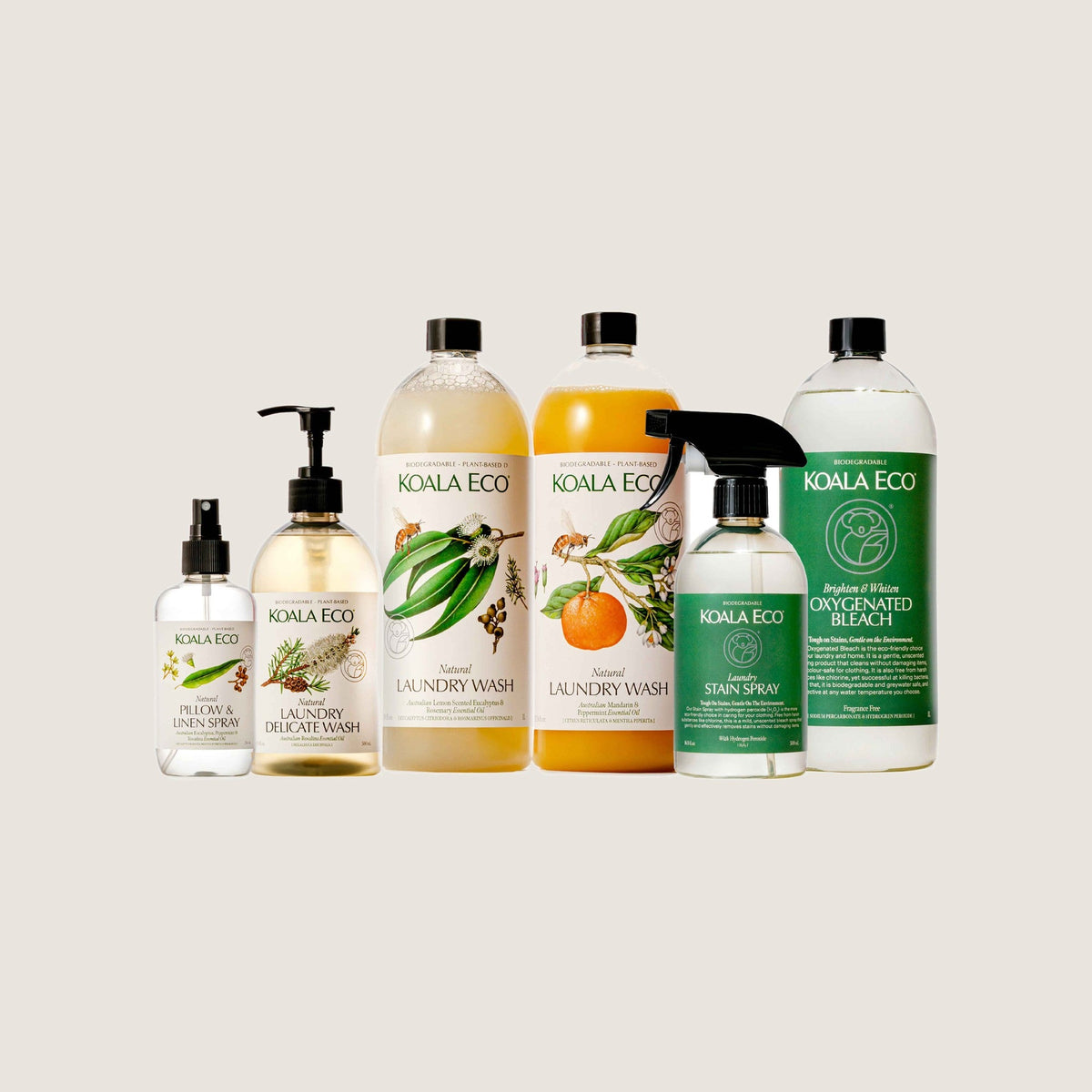
Koala Eco, Lemon-Scented Eucalyptus and Rosemary
- What actually cleans: sodium C14-16 olefin sulfonate and decyl glucoside
- Preservative system: gluconolactone and sodium benzoate
- Fragrance disclosure: essential oils, with the fragrance allergens declared individually
- Packaging: post-consumer recycled. No new plastic was made for it
Barkly Basics, Nectarine and Mint
- What actually cleans: sodium coco-sulphate, coco-glucoside and a coconut-derived non-ionic surfactant
- Preservative system: listed only as preservative. Not named
- Fragrance disclosure: listed as a phthalate-free fragrance
- Packaging: refillable, reusable, recyclable, with a larger refill available
Murchison-Hume, Original Fig
- What actually cleans: cocamidopropyl betaine and sodium C14-16 olefin sulfonate
- Preservative system: phenoxyethanol and benzyl alcohol, both named
- Fragrance disclosure: listed as fragrance, not disclosed
- Packaging: refillable, recyclable
Hetkinen, Wabi-Sabi
- What actually cleans: potassium oleate and potassium cocoate. Actual saponified soap
- Preservative system: none listed. Potassium citrate and citric acid present
- Fragrance disclosure: pine, green tea and peppermint oils, plus an undisclosed parfum
- Packaging: glass, fully recyclable, with a refill available
Why that first row matters
Methylisothiazolinone is a recognised contact allergen. It is a preservative, it works, and it is legal. It is also common enough that European regulators acted twice. Regulation 2016/1198 banned it from all leave-on cosmetics, applying from 12 February 2017. Regulation 2017/1224 then cut the maximum permitted level in rinse-off cosmetics from 100 parts per million to 15, fully applicable from 27 April 2018.
If your hands have been mysteriously irritated for years, the preservative in your hand wash is a reasonable place to look before you blame the weather.
None of the four above use SLS, SLES or methylisothiazolinone. That is checkable rather than a slogan. Murchison-Hume states SLS, paraben and MIT free on its own label, and Koala Eco and Hetkinen name every ingredient they use.
Fragrance is where nearly everyone, us included, could do better. A supermarket bottle says parfum. So does Hetkinen. Murchison-Hume says fragrance. Barkly Basics names only a preservative, so we cannot tell you it is MIT free, only that the brand states it is SLS and paraben free. Koala Eco is the one of the four that declares its fragrance allergens individually.
Where our own shelf is not perfect
Two of the four contain sodium C14-16 olefin sulfonate, a synthetic surfactant. Milder than SLS, and not SLS, but synthetic. Koala Eco, the one most people assume is purest here, is one of the two. Both brands say so on their own labels, which is why we are comfortable stocking them and comfortable telling you.
The scoring trap worth knowing
Koala Eco declares its fragrance allergens individually, because European rules require it above a threshold. Those are naturally occurring components of the essential oils already in the bottle. Scanner apps read them as fragrance allergens and mark the product down.
So the brand that tells you the most gets the worst score for telling you. That is a flaw in the scoring, not the formula.
It is the single most useful thing on this page, and the reason we point people at apps that read the label rather than the barcode.
The app scores are coming, and we will publish them either way
We have not yet run these through Yuka, Think Dirty and EWG, so there are no numbers here. We would rather show you nothing than numbers we invented. When we do publish them, read the columns carefully, because they do not point the same way. Yuka runs 0 to 100 and higher is better. Think Dirty runs 0 to 10 and lower is better. EWG runs 1 to 10 and lower is better.
What we have changed because of this
One correction. An earlier version of this page gave the wrong date and scope for the European limits on methylisothiazolinone. It has been corrected against the regulations themselves and is now right. We would rather show the correction than quietly edit it.
Ingredient lists re-checked against the linked product pages on 27 September 2026. Regulatory dates re-checked 29 September 2026. Formulations change. If the bottle in your hand disagrees with this page, the bottle wins, and we would like to know.
Keep reading
- Start with whatever touches you longest, on how to prioritise swaps by contact time rather than by how alarming an ingredient sounds
- What low-tox cleaning actually means
- Browse the bathroom, cleaning and plastic free edits

Written by Felicia Byrne